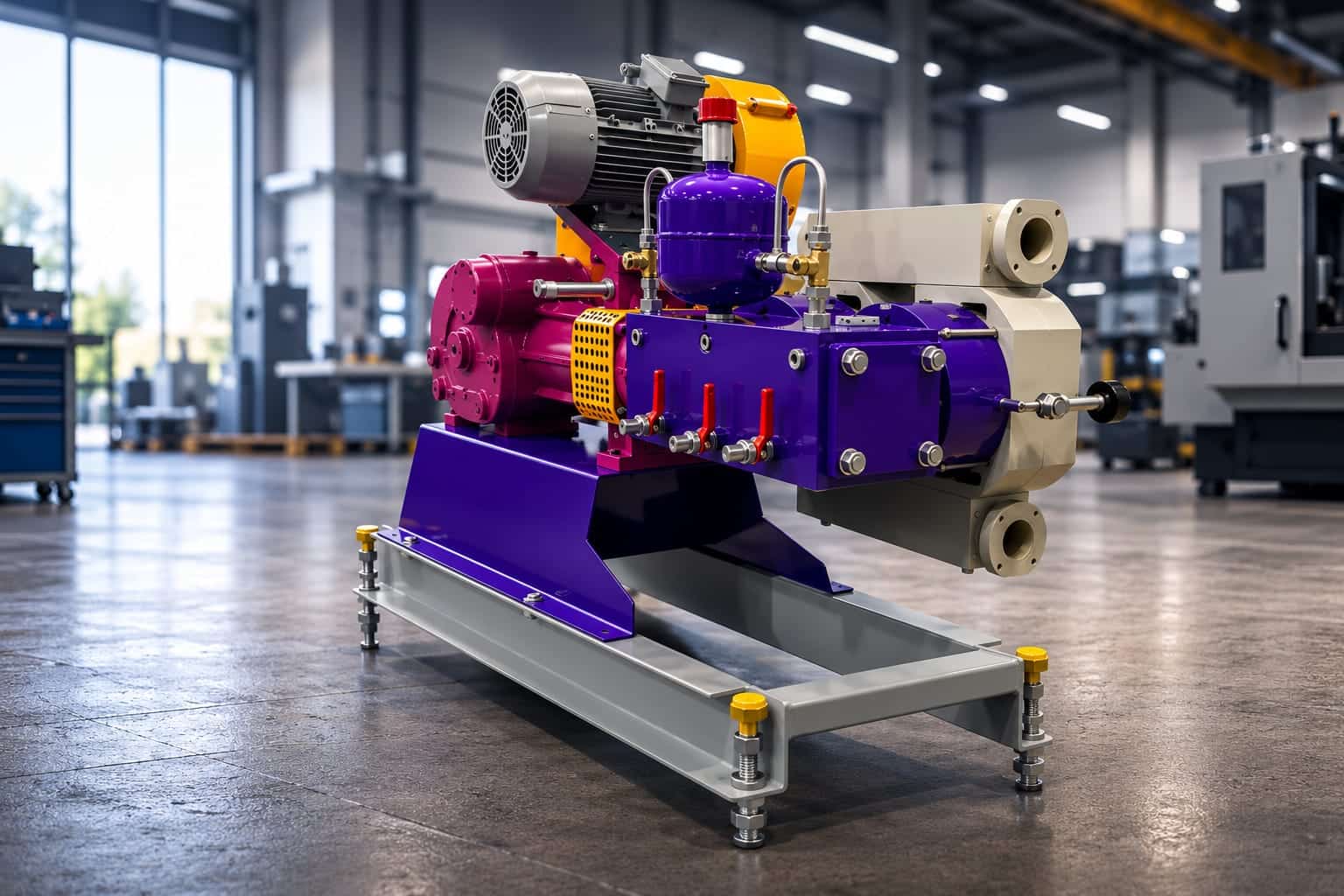
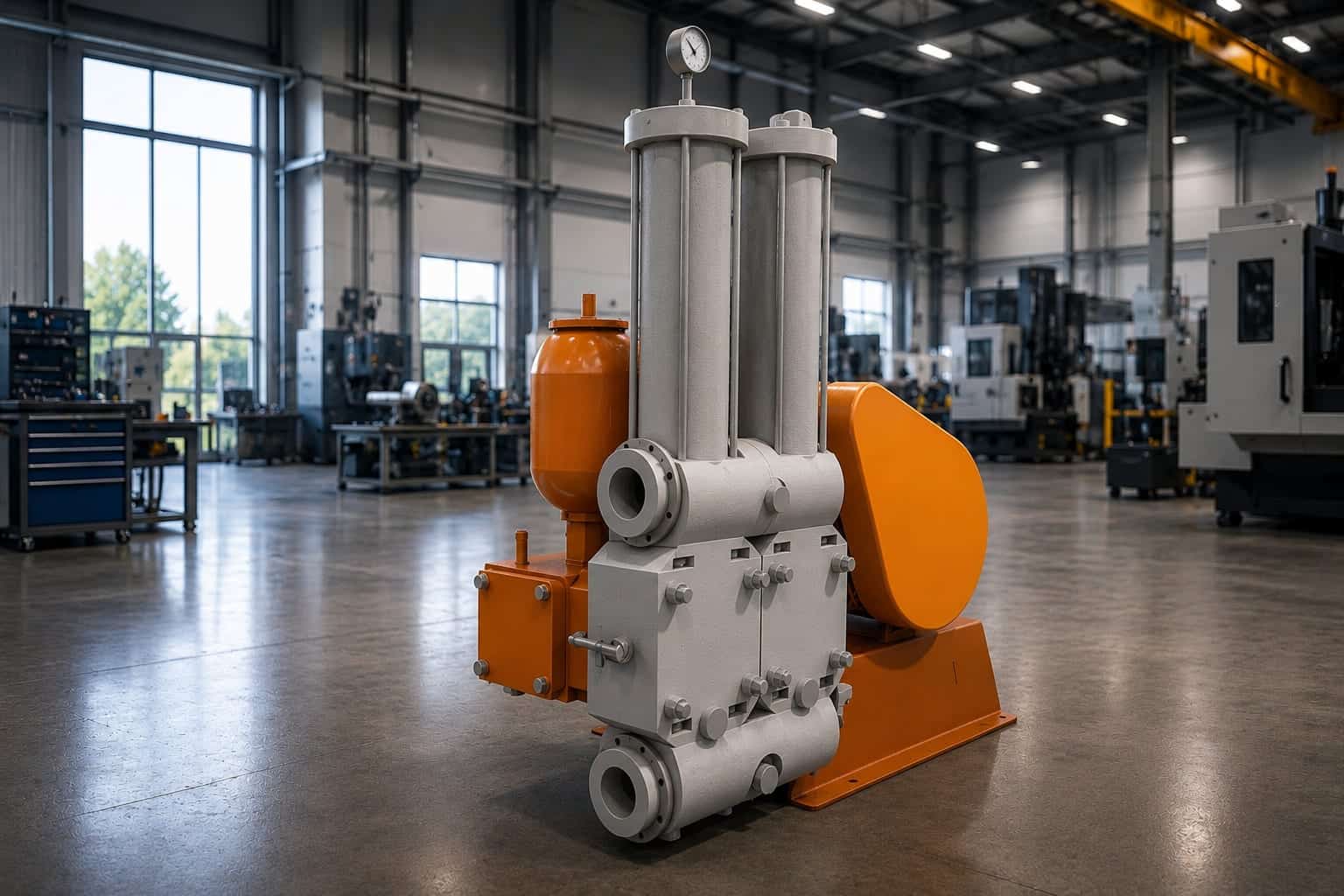
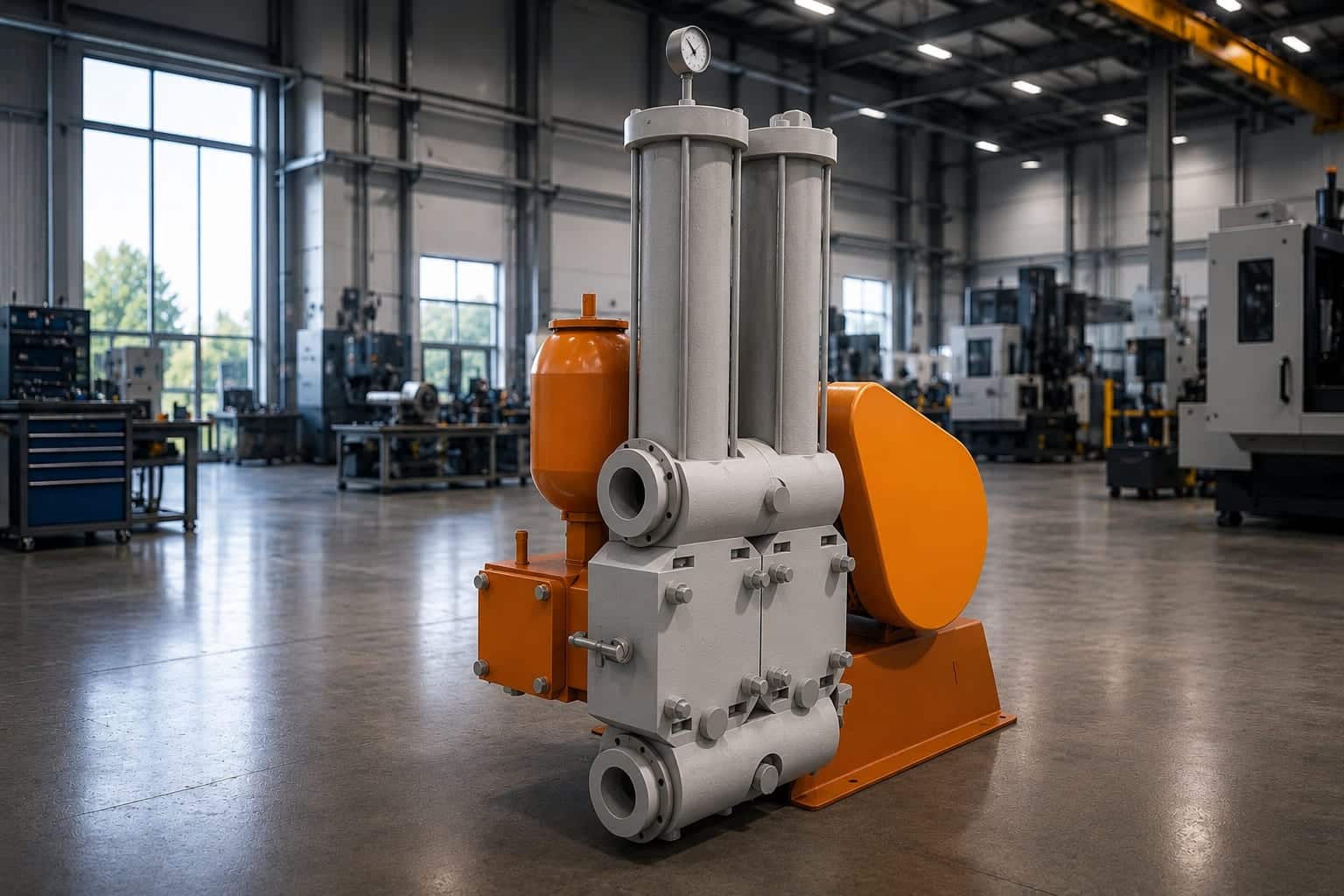
Filter press pump
Model FP
The patent-pending solution for filter presses where process stability and result quality matter. Less downtime, more predictability.
For demanding filtration
Shorter cycle times
Stable pressure build-up across the entire filter cycle.
Drier cake
Better dewatering at the end of the cycle — less residual moisture in the filter cake.
Lower energy demand
High efficiencies and economical motor sizing.
High operational reliability
Dry-run safe and protected with the suction or discharge line closed.
Electronic control and automation
Works without a PLC or variable frequency drive — integration into a higher-level control system remains possible at any time.
Hydraulic control
Adapts its flow to the press fill level automatically; the control curve is freely adjustable.
A specialist, not a generalist
Many pumps feed filter presses. But few were developed for it. Other designs are generalists: they handle a wide range of duties and can, in principle, feed a filter press too — often only with compromises. Higher energy consumption, heavy wear, elaborate control technology, additional sensors or sensitive behaviour under unusual operating conditions.
The Model FP is a specialist. It was developed consistently for the demands of filter press feeding, and it does not merely convey the medium — it actively shapes the filtration process by giving the press exactly what it needs at every moment.
The right flow across the whole cycle
At the start of filling, the Model FP delivers a precisely defined flow — fast enough for short cycle times, yet gentle so as not to strain pipes, valves and filter cloths unnecessarily.
While the pressure in the press rises continuously, the flow stays constant. Only when the process calls for a reduction does the internal hydraulics adjust it in a controlled way — the pump always working at its hydraulic optimum, without elaborate external control technology or complex automation.
In the final phase, too, it plays to its strength: it reliably generates high end pressures up to 16 bar, producing an evenly dewatered, dry filter cake and reproducible results.
Robust in operation, simple to service
One advantage shows in daily plant operation: dry running from empty tanks, a blocked suction line or other unusual operating conditions do not lead directly to damage. The Model FP is designed for these situations and stays reliable even under difficult conditions.
If maintenance is ever needed, all wear-relevant components are easily accessible and quickly replaced — without special tools and, in many cases, without a manufacturer's service technician. That reduces downtime and increases plant availability.
How the Model FP controls the filtration process
At its heart is a gearbox-driven piston oscillating in the hydraulic cylinder. It alternately pressurises two chambers filled with hydraulic fluid; each is connected to the pump head by a diaphragm.
When the piston displaces a given volume of hydraulic fluid, the diaphragm moves by exactly that volume — and on the medium side the same amount of fluid is displaced. The flow is thus defined directly by the piston stroke.
As the pressure in the press rises, the flow first stays unchanged. Only from an adjustable point do the hydraulic flow regulators engage, which also act as energy storage and feed the absorbed energy back into the process. The flow then falls in a controlled, continuous way — with no speed change, no variable-frequency drive and no external control valves.
Key figures
What the series delivers
The following figures apply across both series and all frame sizes. The specific design of your pump — flow rate, connection sizes, materials — comes with the technical data sheet we send in response to your enquiry.
- Solids content
- up to 50 %
- Depending on the size and shape of the solids. The pump handles liquids carrying solids.
- Particle size
- up to 30 % of the pipe diameter
- At DN 100 that corresponds to roughly 30 mm.
- Average valve speed
- max. 3–4 km/h
- Limited by design. The comparatively low speed keeps wear on the valve seat and valve cage low.
- Operating pressure
- up to 16 bar
- Without affecting diaphragm life: the diaphragm is hydraulically guided and stays close to force-free.
- Residual pulsation
- below 10 %
- In the standard configuration with a dampener. Where less is required, the dampener can be designed for below 1 %.
- Dampener recommended above
- approx. 6 bar
- Below that, most applications run without a pulsation dampener.
- Overall efficiency
- above 90 %
- At the best efficiency point — large frame size, high pressure, pump fully utilised. Calculated including mechanical losses, not just inside the pump head.
- Diaphragm rupture detection
- standard
- An analogue indicator is part of the standard scope; electronic monitoring is available as an option.
All figures describe the design, not a single duty point. Which values your process reaches depends on the medium, the solids content and the operating profile.
Frequently asked questions
Why does a filter press need a special pump?
Because the operating point changes considerably over the cycle: from thin and pressureless at the start to high back pressure with a largely filled plate pack at the end. A pump that only covers one operating point well loses performance towards the end of the cycle — exactly when the pressure is needed to dewater the cake.
How does Model FP affect the residual moisture in the filter cake?
The stable pressure build-up across the entire cycle ensures that the press sees the necessary pressure at the end of the cycle. The result is a drier cake and therefore less effort in drying, transport and disposal.
What happens if the suction line is closed?
The pump remains protected and takes no damage — that is the core of the patent-pending design principle and applies to a closed suction line. This is a frequent damage case with conventional pumps in filtration operation.
Does the pump cope with a fluctuating solids content?
Yes. The pump is designed to resist wear and works reliably during start-up, with changing solids contents and in continuous operation — without readjustment for every batch.
Is Model FP suitable for corrosive media?
The wetted parts are made of chemically resistant plastic, which makes them the safe choice for corrosive media and aggressive process conditions. The hermetically sealed design additionally increases safety when handling critical media.
Can Model FP be retrofitted to an existing filter press?
As a rule, the existing pump can be replaced by a HODD pump. We are happy to support you on site with needs-based sizing and planning.
How is the HODD pump sized for filter press feed?
The data of the existing pump is of interest to us, but not the deciding factor. As our pumps are specialists for filtration, we base the sizing above all on the capacity of the press and your sludge volume. We therefore need the plate dimensions, the number of plates, the cake thickness and the maximum pressure.
What technical data is available?
Sizing is done on an application-specific basis. Send us the medium, solids content, flow rate and the required final pressure; you will receive the appropriate technical data sheet from us.
Contact
We are happy to advise you personally — simply send us your enquiry via the form. For reliable sizing it helps us to have details on the medium, solids content, flow rate and pressure requirement.