Technology
How a hydraulically operated double-diaphragm pump works — and what that means for solids, priming, cavitation, pulsation and energy consumption. The questions we are asked most often, answered in full.
The working principle
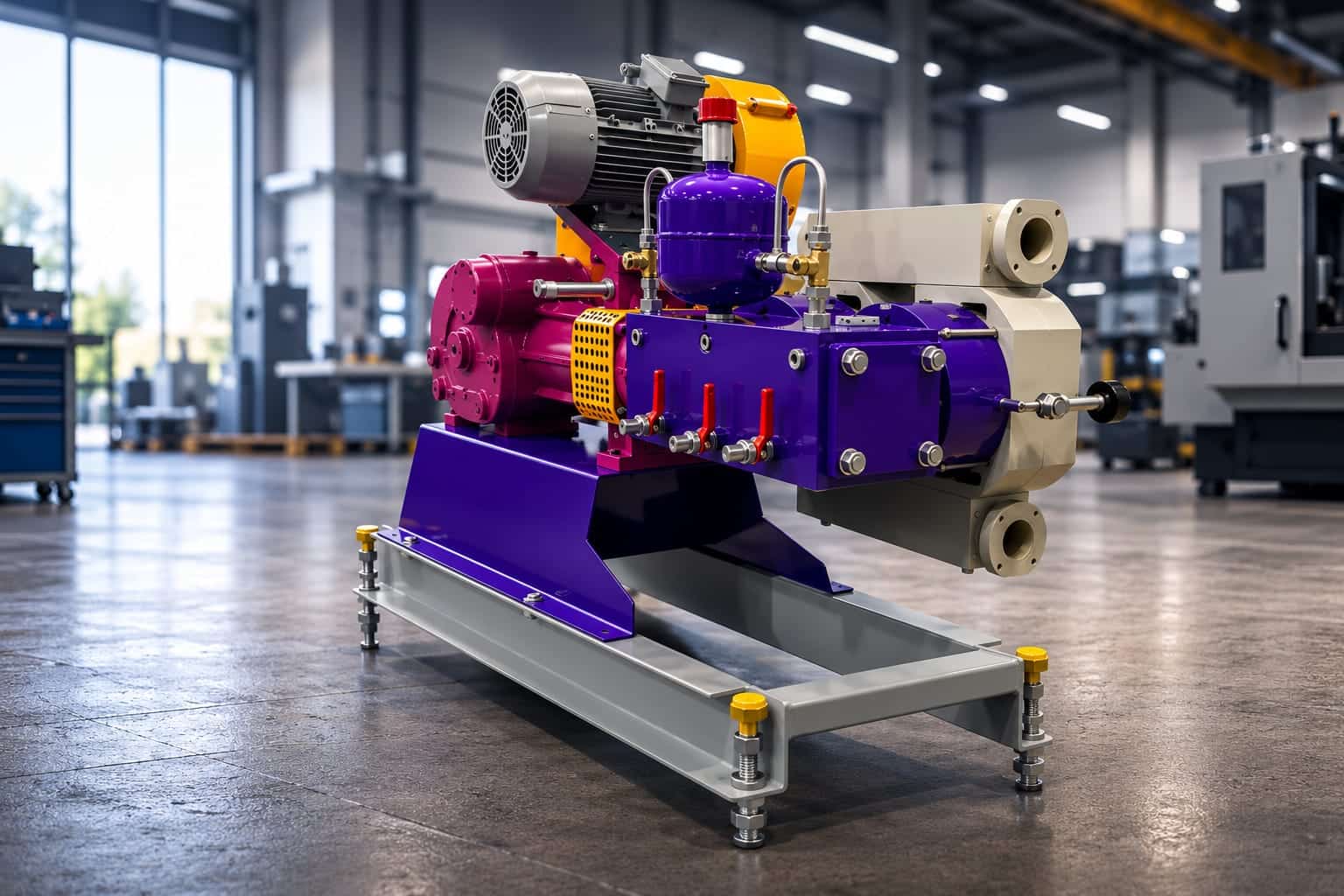
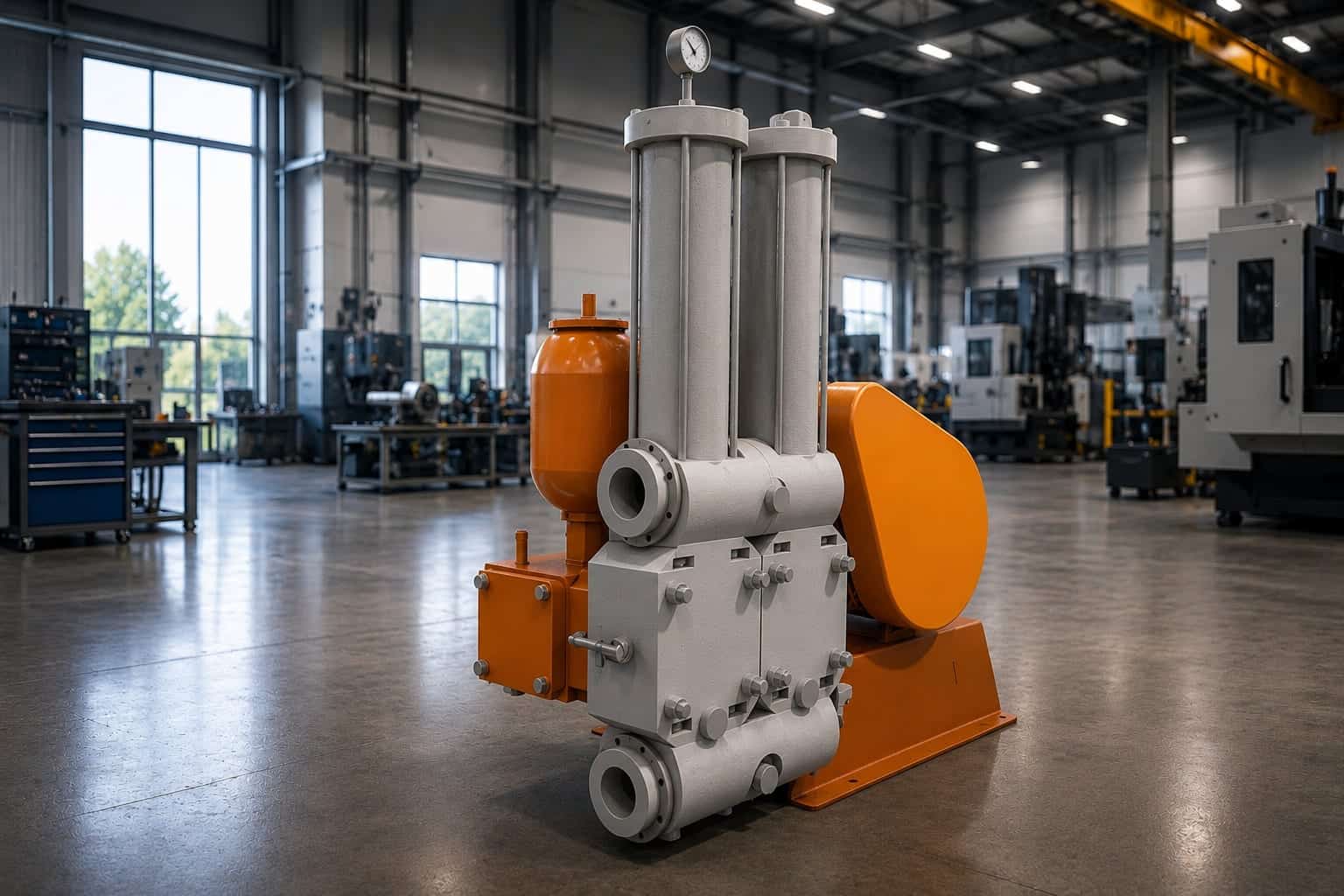
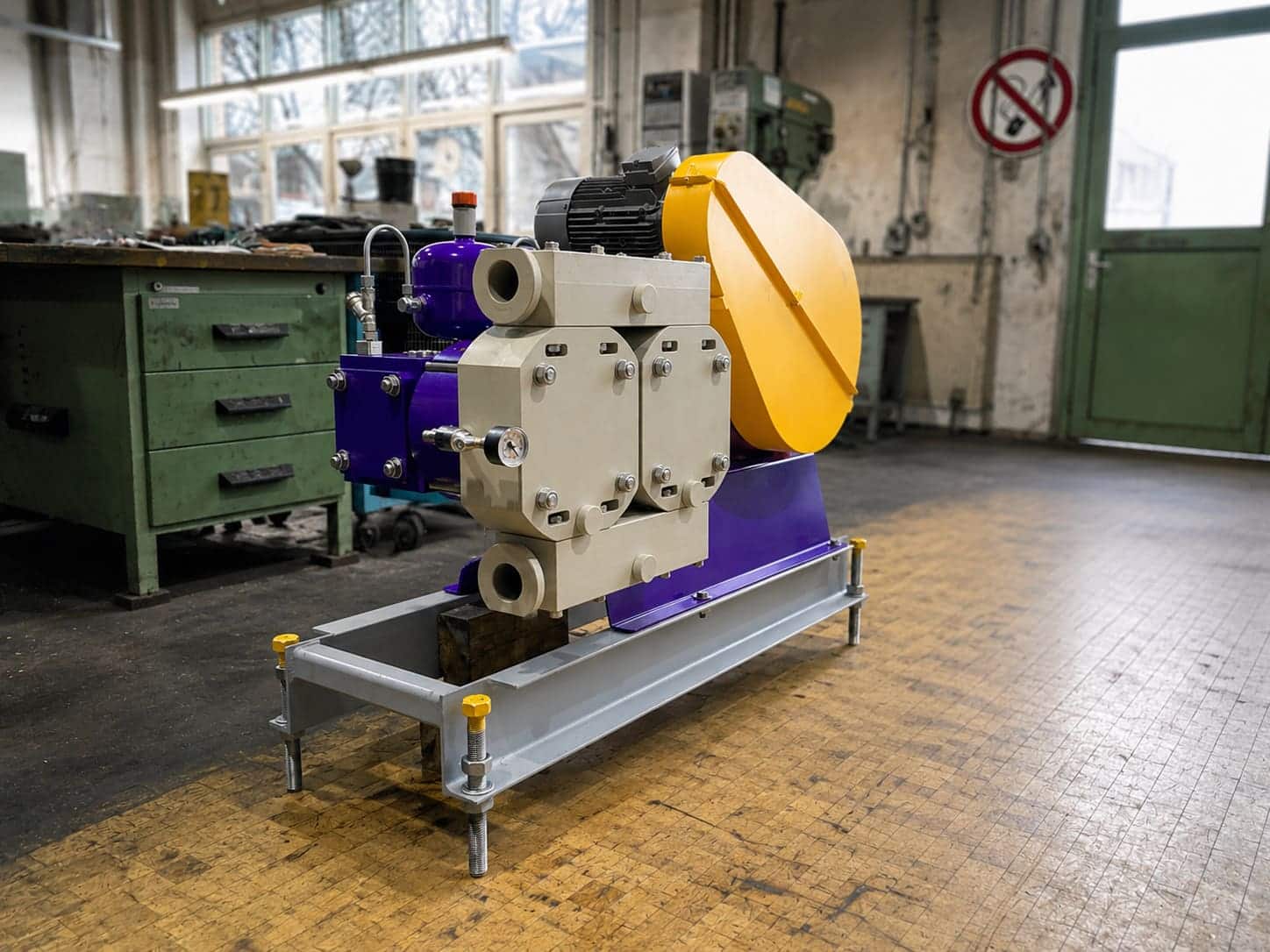
HODD stands for Hydraulic Operated Double Diaphragm. The diaphragm separates the drive side, the pump cylinder, from the wet end, the pump head. It is moved neither mechanically nor by compressed air, but by a hydraulic fluid.
That leads to the decisive difference: diaphragm position is hydraulically controlled in every operating condition. The diaphragm itself stays close to force-free — it separates two chambers instead of having to carry the pressure difference. Solids content and discharge pressure therefore have no direct effect on its service life.
The movement of the diaphragm guides pressure into the pump head, where check valves give the medium its direction. Because the diaphragm stays under control, operating conditions become manageable that damage other pump types: dry running on an empty tank, a blocked or closed suction line, self-priming and operation at low suction pressure. Low flow at high pressure can be generated efficiently, too, without compromising service life.
Key figures
What the series delivers
The following figures apply across both series and all frame sizes. The specific design of your pump — flow rate, connection sizes, materials — comes with the technical data sheet we send in response to your enquiry.
- Solids content
- up to 50 %
- Depending on the size and shape of the solids. The pump handles liquids carrying solids.
- Particle size
- up to 30 % of the pipe diameter
- At DN 100 that corresponds to roughly 30 mm.
- Average valve speed
- max. 3–4 km/h
- Limited by design. The comparatively low speed keeps wear on the valve seat and valve cage low.
- Operating pressure
- up to 16 bar
- Without affecting diaphragm life: the diaphragm is hydraulically guided and stays close to force-free.
- Residual pulsation
- below 10 %
- In the standard configuration with a dampener. Where less is required, the dampener can be designed for below 1 %.
- Dampener recommended above
- approx. 6 bar
- Below that, most applications run without a pulsation dampener.
- Overall efficiency
- above 90 %
- At the best efficiency point — large frame size, high pressure, pump fully utilised. Calculated including mechanical losses, not just inside the pump head.
- Diaphragm rupture detection
- standard
- An analogue indicator is part of the standard scope; electronic monitoring is available as an option.
All figures describe the design, not a single duty point. Which values your process reaches depends on the medium, the solids content and the operating profile.
Frequently asked
Five topics that come up before every sizing
Answered in detail — so you can judge whether the design suits your process before the first phone call.
Solids handling
How much solid content the pump takes, where it wears and what to do about a blockage.
How much solid content can the pump handle?
Up to 50 %, depending on the size and shape of the solids. Worth keeping in mind: a pump is a device for liquids. Solids carried in them are fine.
What particle size can the pump handle?
Up to 30 % of the pipe diameter. At DN 100 that corresponds to roughly 30 mm.
What happens if a check valve is blocked?
The pump stops delivering liquid, because no pressure can build up while a valve is held open. As a rule no damage occurs — only the delivery stops.
How do I clear a blocked valve?
In this order: flush with clean fluid from the suction side; open the drain connection on the pump to inspect and remove the blockage; and if that is not enough, remove the affected traverse and clean it.
What wear should I expect, and on which parts?
The average valve speed is limited by design to a maximum of 3 to 4 km/h. That comparatively low speed keeps wear low. Over long operating periods it shows first on the valve cage and the valve seat — both easily replaceable parts.
With solids, what is the difference from a peristaltic pump?
The hose of a peristaltic pump is not force-free: it is squeezed on every revolution, and that constant deformation limits its service life. Solids content and discharge pressure act on it directly, and the hose tension has to be adjusted to the discharge pressure. In a HODD pump the diaphragm is hydraulically guided and stays close to force-free. HODD pumps achieve considerably higher efficiencies.
What is the difference from progressive cavity and other rotating pumps?
There, solids are caught between static and rotating elements. Solids content and pressure act directly on the service life of exactly those parts that create the pumping action — and replacing them is demanding, because they are the core of the pump.
What is the difference from pumps with mechanical seals?
Pumps with mechanical seals carry the risk that solids migrate into the sealing gap, salts crystallise out or dry running occurs. HODD pumps seal hermetically via the diaphragm — all the challenges and risks that come with operating mechanical seals are eliminated.
Self-priming
What really limits suction head — and why it is usually not the pump.
How many metres can the pump prime by itself?
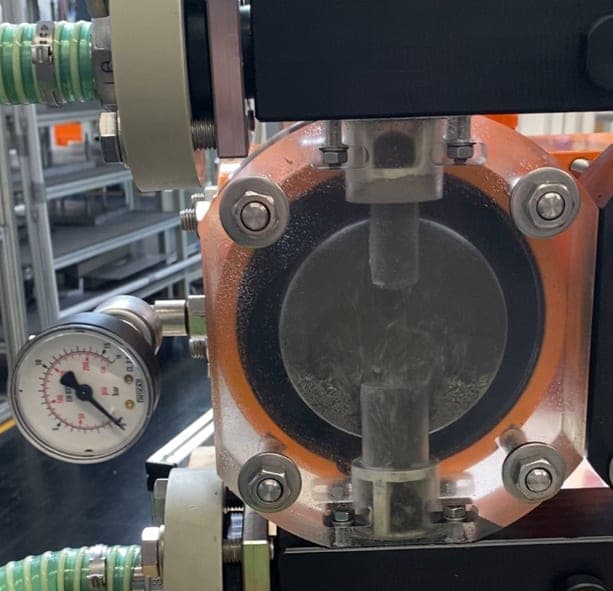
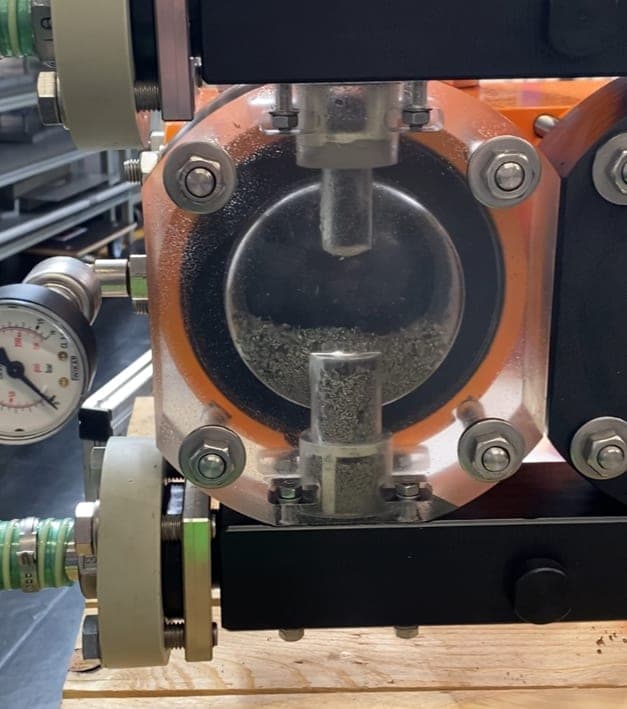
The pump creates a suction head that few other technologies reach. In practice the suction pipework, not the pump, sets the limit: at high suction lift even a small leak at a flange or a valve draws in air — and that is what limits the result.
What happens if air gets into the suction line?
As soon as air enters the suction line, whether through leaks or by outgassing from the liquid, the volume pumped drops. No damage occurs.
What role does viscosity play?
A more viscous liquid increases losses on the suction side. Critical conditions occur earlier than with water, and the volume delivered drops accordingly.
What role does the volume of the suction line play?
When priming, the pump first has to move the air out of the suction line to the discharge side before the liquid column follows. If the suction line contains horizontal sections, or if its nominal diameter is larger than that of the pump, it should be pre-filled.
Cavitation
Why a condition that destroys other diaphragm pumps only costs flow here.
What does cavitation look like on a HODD pump?
Under low pressure, vapour bubbles build up inside the pump. Their build-up and collapse follow the piston speed — so both happen at moderate speed.
How do I recognise it from the outside?
By the reduced volume pumped.
What is the risk for the pump?
Operation in cavitation poses no risk for HODD technology.
Why do conventional diaphragm pumps fail under cavitation, but this one does not?
HODD technology keeps control of the diaphragm at all times in critical operating conditions — such as cavitation.
What does my application gain from that?
Plants rarely run under constant conditions. When emptying a tank, for instance, the starting conditions are uncritical but change continuously as the level drops. Conventional pumps run into trouble there. A HODD pump can be driven straight through the critical range — with some loss in volume, but without damage.
And if the suction line is fully closed?
The pump survives that too: both a suction line accidentally blocked by solids and one closed by a wrongly actuated valve.
Pulsation
When a dampener is needed, how much residual pulsation remains and why pipework shakes.
How big is the pulsation?
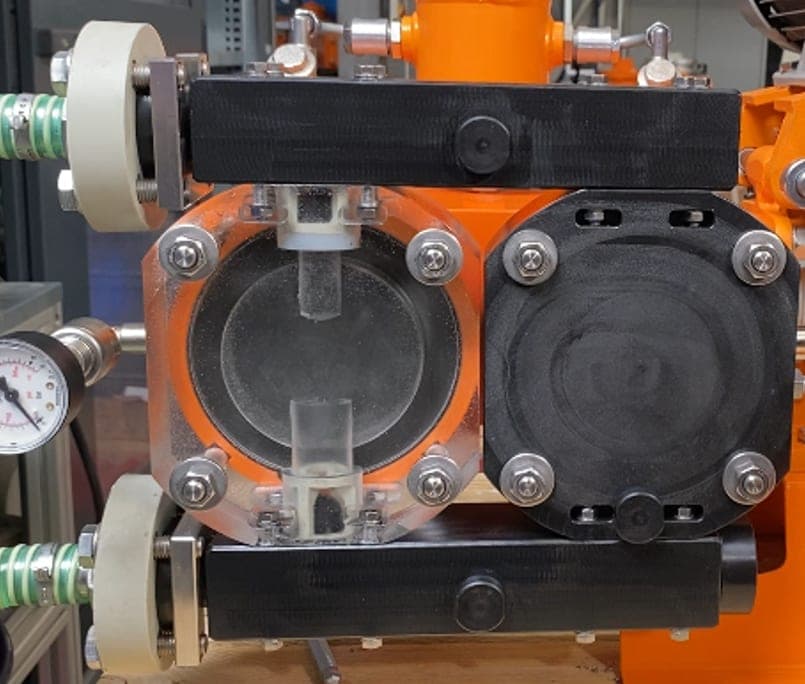
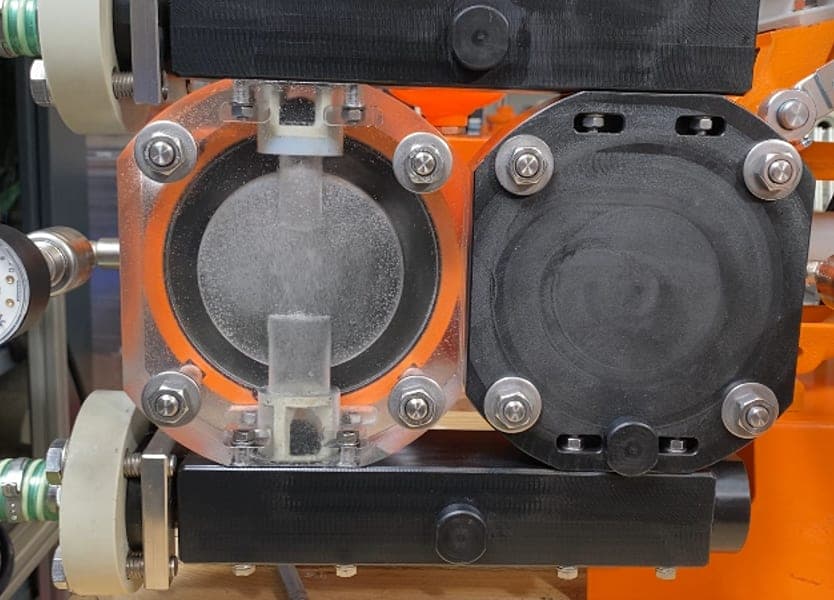
Without dampening, the swing shown on the gauge is as big as the discharge pressure. That is inherent to positive displacement pumps.
My pipes shake when a displacement pump runs. Why?
Usually because of the pipe design. What helps: a straight section of pipe at the pump outlet, no elbows directly behind the pump, no hoses — and pipework properly fixed in all directions.
Do I need a pulsation dampener?
It depends on the application. Up to around 6 bar we usually work without one; at higher pressures a dampener becomes increasingly advisable.
How much residual pulsation remains after dampening?
Below 10 % as standard. Where less is required, it is a question of how the dampener is designed — below 1 % is achievable.
When do you use active and when passive dampening?
Active dampening with a diaphragm dampener when the discharge pressure is constant. Passive dampening with an air vessel when it changes strongly. The best example is filter press feeding: the start pressure is around 1 bar, the end pressure up to 16 bar. That calls for a system which adapts itself at every moment.
How does passive dampening work, and does it consume much air?
We inject a small breath of air on the suction side, at the point of low pressure. That air settles in the air vessel on the discharge side and builds an air cushion which damps the pulsation down to a minimum. If the pump is self-priming, the air can be drawn from the atmosphere.
Energy efficiency
Why overall efficiency is the figure that counts, and how it compares to other pump types.
What efficiency does the pump reach?
Up to above 90 % overall efficiency — reachable at the best efficiency point given a suitable duty point. As a rule, at elevated pressures our technology is considerably more efficient than, for example, rotating pumps, because there is hardly any internal friction.
Other suppliers also state above 90 %. Where is the difference?
They usually mean hydraulic efficiency, created inside the pump head. What matters for the electricity bill is overall efficiency: hydraulic efficiency plus the mechanical losses in gearbox, belt and drive. We count overall efficiency, and the expected energy consumption is stated in our data sheet.
Why does efficiency rise with pressure?
Because the mechanical losses of our pump are almost independent of the duty point. The higher the pressure, the bigger the leverage of the hydraulics — and the better the overall efficiency.
How does the pump compare to other displacement pumps?
Significantly better. In lobe, progressive cavity and peristaltic pumps the working principle is based on friction, and friction is lost energy.
And compared to centrifugal pumps?
Centrifugal pumps are very efficient when flow determines the duty point — high flow is their strength. When pressure determines the duty point, the centrifugal pump runs in partial load. That is exactly where the HODD pump has the advantage.
What is the role of the flow regulator on the filter press pump?
The feed rate adapts hydraulically to the demand of the press — in every operating condition. This feeds the press ideally: energy-efficient, low-wear and with an optimal filter cake as the result.
When is a centrifugal pump the better choice, and when a HODD pump?
Centrifugal pumps are strong where high flow at low pressure is needed — that is their economical best point. As soon as pressure determines the duty point, with low flow at high pressure, or where high suction lift, dry running, abrasive or corrosive media and critical suction conditions come into play, the HODD pump plays to its strength. Tell us your duty point and we will tell you openly which design is more economical.
What is the most efficient way to feed a large filter press?
On large filter presses the strengths of both designs can be combined. In the filling phase a centrifugal pump quickly brings volume into the press — high flow at low pressure, its economical range. As the back pressure rises and the centrifugal pump reaches its minimum flow, the HODD pump takes over: it keeps the flow constant even as the pressure rises markedly towards the end of the compression phase. Each pump then works in its best range — which noticeably lowers investment and operating costs on large installations.
Design comparison
AODD, EODD, HODD — where the difference lies
Double-diaphragm pumps differ above all in how the diaphragm is moved. Service life, energy demand and behaviour in borderline conditions all follow from that.
AODD
Air operated double-diaphragm pump
Operating principle
- 01Compressed air is supplied.
- 02An air valve controls the switching between the chambers.
- 03The compressed air moves the diaphragm directly.
- 04The process fluid is pumped.
- Advantage: Proven technology with a simple design. With no electrics on the pump, it can also be used in explosion-risk areas.
- Limitation: The diaphragm carries the pressure difference itself. Solids content and discharge pressure therefore act directly on its service life.
- Limitation: Compressed air is one of the most expensive ways to drive a pump: it has to be generated at considerable effort, a substantial share of the energy is lost between compressor and consumer, and the pumps themselves consume large amounts of it.
EODD
Electrically operated double-diaphragm pump
Operating principle
- 01An electric motor drives an eccentric mechanism.
- 02The mechanism moves the diaphragm mechanically.
- 03The process fluid is pumped.
- Advantage: Considerably more energy efficient than an air drive, because the energy is transferred without the detour through a compressed air network.
- Limitation: The force acts mechanically on the diaphragm. As the required pressure rises, diaphragm life drops markedly — which limits the sensible operating range at the top end.
- Limitation: The volume delivered drops under suction lift conditions.
- Limitation: Drive and pump form one structural unit. If the pump stands in a corrosive atmosphere, next to an acid tank for instance, the electronics are exposed to the same fumes as the wet end.
HODD
Hydraulic operated double-diaphragm pump
Operating principle
- 01A hydraulic cylinder generates the deflection of the diaphragms.
- 02The hydraulic fluid moves the diaphragm and controls its position in every operating condition.
- 03The process fluid is pumped.
- Advantage: The diaphragm stays close to force-free. Solids content and discharge pressure have no direct effect on its service life.
- Advantage: Operating pressure up to 16 bar without compromising diaphragm life.
- Advantage: Even in suction operation the flow rate stays constant.
- Advantage: Dry running, a blocked or closed suction line and operation in cavitation are survived without damage — the pump may deliver less in those conditions, but takes no harm.
- Advantage: Electric motor and wet end sit apart from each other. Damage to the motor stays a motor problem instead of writing off the whole pump.
- Advantage: Above 90 % overall efficiency at the best efficiency point — calculated including mechanical losses, not just inside the pump head.
- Advantage: Double-diaphragm technology with monitoring: damage is detected before any leakage occurs.
The comparison describes pump types, not individual makes. How a specific pump behaves also depends on its design, its materials and the duty point.
Contact
We are happy to advise you personally — simply send us your enquiry via the form. For reliable sizing it helps us to have details on the medium, solids content, flow rate and pressure requirement.